Epigenetic regulation lies at the core of cellular identity, developmental programs, and transcriptional control. While DNA sequence provides the blueprint, it is the chromatin landscape—the dynamic organization of DNA and associated proteins—that determines which genes are accessible, active, or silenced. As a result, technologies that accurately map protein–DNA interactions are essential tools in modern genomics research.
Among these technologies, CUT&Tag (Cleavage Under Targets and Tagmentation) has emerged as a next-generation chromatin profiling method, offering high resolution, low background noise, and dramatically reduced input requirements. At AffiGEN®, this approach aligns with the company’s focus on precision molecular biology tools designed to simplify complex workflows while maintaining scientific rigor.
This in-depth article explores CUT&Tag technology from first principles, covering its biochemical foundation, experimental design, laboratory workflow, quality control strategies, data analysis considerations, limitations, and future directions—culminating in an introduction to the AffiGEN® CUT&Tag Assay Kit.
Chromatin profiling: a foundation of epigenomics research
Chromatin profiling aims to map the genomic locations of:
-
Transcription factors
-
Histone modifications
-
Chromatin-associated regulatory proteins
These maps provide insight into gene regulation, enhancer activity, epigenetic memory, and cellular differentiation. Large-scale efforts such as ENCODE and the NIH Roadmap Epigenomics Project have demonstrated the value of chromatin profiling for understanding genome function (ENCODE Project overview, NIH Roadmap Epigenomics).
Public data repositories like the NCBI Gene Expression Omnibus (GEO) and the Sequence Read Archive (SRA) now host vast numbers of chromatin datasets, underscoring the importance of standardized, reproducible profiling methods (NCBI GEO, NCBI SRA).

Limitations of traditional ChIP-seq workflows
Chromatin immunoprecipitation followed by sequencing (ChIP-seq) has long been the gold standard for mapping protein–DNA interactions. However, NIH-supported reviews have identified several inherent challenges (NIH ChIP-seq review):
-
High cell number requirements
-
Sonication-induced variability
-
Substantial background signal
-
Lengthy, multi-day workflows
-
Limited suitability for rare or precious samples
These limitations motivated the development of in situ chromatin profiling methods that minimize sample handling and maximize signal specificity.
CUT&Tag: conceptual and biochemical foundations
CUT&Tag (Cleavage Under Targets and Tagmentation) is an antibody-directed chromatin profiling technique in which adapter insertion occurs directly at protein-bound genomic loci inside intact nuclei.
The key innovation is the use of a protein A/G–Tn5 transposase fusion, which combines:
-
Antibody binding specificity (via protein A/G)
-
Transposase-mediated adapter insertion (via Tn5)
This strategy was first described in seminal academic work by the Henikoff laboratory (Henikoff et al., 2019) and further refined in subsequent methodological studies (CUT&Tag protocol review).
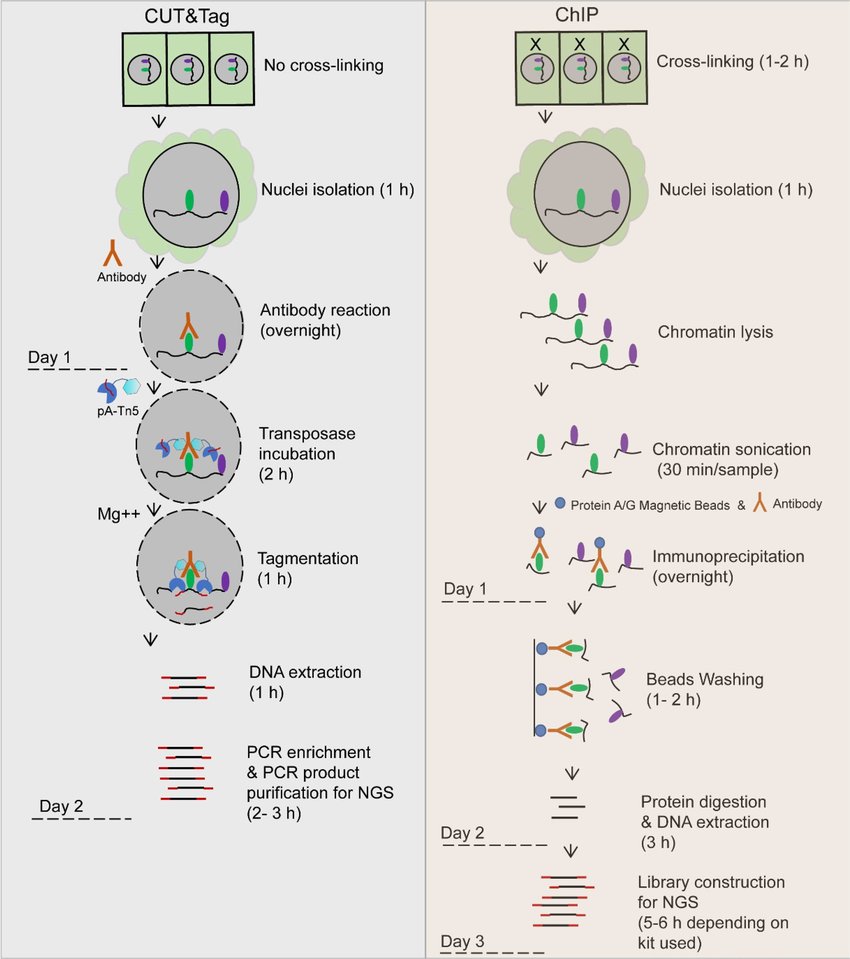
How CUT&Tag works: step-by-step overview
A typical CUT&Tag workflow includes:
-
Cell or nuclei immobilization
Cells are gently permeabilized and immobilized, often using magnetic beads to enable efficient washing. -
Primary antibody incubation
A target-specific antibody binds a chromatin protein or histone modification of interest. -
Secondary antibody binding
Enhances recruitment of the protein A/G–Tn5 fusion. -
Targeted tagmentation
Upon activation, Tn5 inserts sequencing adapters directly adjacent to antibody-bound sites. -
DNA release and purification
Adapter-tagged fragments are released and purified. -
PCR amplification and indexing
Libraries are amplified and indexed for multiplexed sequencing. -
Library QC and sequencing
Fragment size distribution and concentration are assessed prior to sequencing.
Library preparation metadata must be reported accurately for public data submission (NCBI SRA metadata guidelines).
Scientific advantages of CUT&Tag technology
Ultra-low input compatibility
CUT&Tag routinely performs well with hundreds to thousands of cells, enabling epigenomic studies in rare cell populations (NIH low-input epigenomics review).
High signal-to-noise ratio
Because tagmentation occurs only at antibody-bound loci, background DNA is minimized, improving peak clarity and reducing sequencing depth requirements (ENCODE chromatin profiling standards).
Streamlined experimental workflow
By eliminating sonication and immunoprecipitation, CUT&Tag reduces variability and hands-on time, improving reproducibility across batches and operators.
Core applications in epigenetics and gene regulation
Histone modification mapping
CUT&Tag is widely used to profile histone marks such as H3K4me3, H3K27ac, and H3K27me3—key indicators of promoter and enhancer states (NIH histone modification overview).
Transcription factor binding analysis
CUT&Tag enables precise mapping of transcription factor occupancy, supporting studies of transcriptional networks and regulatory circuits (NCBI transcription factor resources).
Developmental biology and cell identity studies
Low-input compatibility makes CUT&Tag suitable for developmental time-course experiments and lineage tracing studies (NIH epigenomics roadmap).
Single-cell adaptations
CUT&Tag has inspired single-cell chromatin profiling methods that address cellular heterogeneity (NIH single-cell epigenomics).
Quality control and data analysis considerations
Antibody validation
Antibody specificity is critical. NIH guidelines emphasize rigorous antibody validation for chromatin applications (NIH antibody validation guidance).
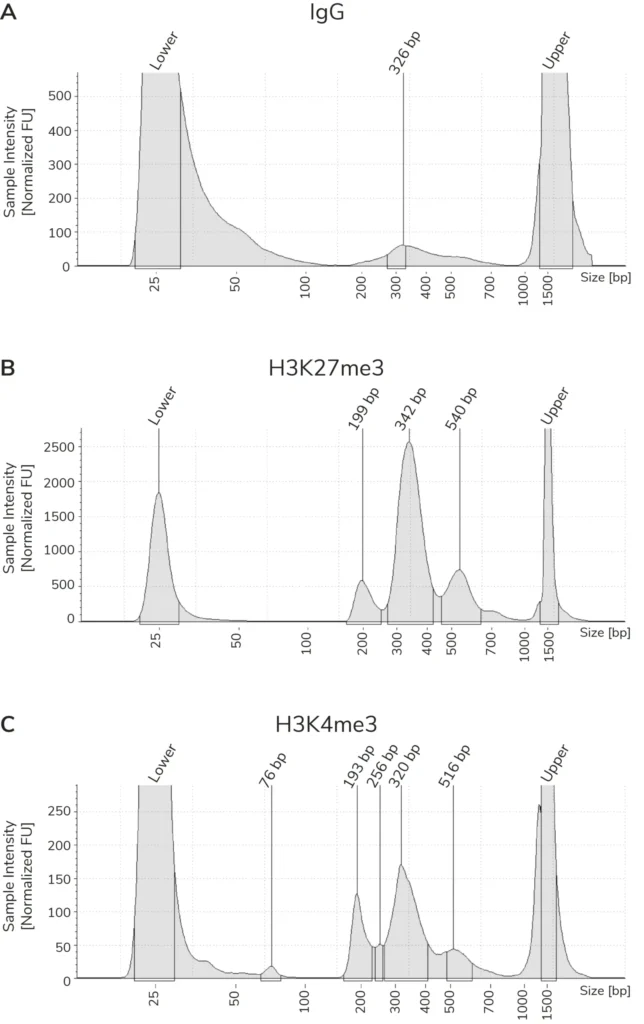
Library size profiles
CUT&Tag libraries often show enrichment of mono- and di-nucleosomal fragments. Sequencing cores recommend verifying fragment distributions prior to sequencing (UC Davis library QC guidelines).
Data quality metrics
Key metrics include:
-
Fraction of reads in peaks (FRiP)
-
Peak reproducibility
-
Background signal levels
ENCODE data standards provide benchmarks for evaluating chromatin datasets (ENCODE data standards).
CUT&Tag vs ChIP-seq vs CUT&RUN
| Feature | CUT&Tag | CUT&RUN | ChIP-seq |
|---|---|---|---|
| Input requirement | Very low | Low | High |
| Background noise | Very low | Low | Moderate–High |
| Workflow length | Short | Short | Long |
| Sonication required | No | No | Yes |
| Library prep complexity | Low | Low | High |
CUT&Tag’s integrated tagmentation step distinguishes it from CUT&RUN, further simplifying library preparation.
Documentation and public data submission
Accurate metadata reporting is essential for reproducibility and compliance with public repositories. Required fields typically include:
-
Assay type (CUT&Tag)
-
Antibody target
-
Cell type and input
-
Library preparation method
(NCBI GEO submission guidelines, NCBI SRA submission overview).
CUT&Tag assay kit, chromatin profiling assay, epigenomics sequencing, transcription factor mapping, histone modification analysis, low-input epigenomics, tagmentation-based chromatin profiling, high-resolution epigenetic mapping.
Introducing the AffiGEN® CUT&Tag Assay Kit
The AffiGEN® CUT&Tag Assay Kit is developed to support robust, reproducible, and accessible chromatin profiling in modern research laboratories. In line with AffiGEN®’s commitment to precision life-science tools, the kit is designed for:
-
Histone modification profiling
-
Transcription factor binding studies
-
Low-input and rare cell samples
-
Routine and high-throughput epigenomics workflows
By combining antibody-guided specificity with in situ tagmentation, the AffiGEN® CUT&Tag Assay Kit helps laboratories generate high-quality epigenomic data while reducing workflow complexity.
Future perspectives
As epigenomics continues to integrate with single-cell analysis, spatial genomics, and multi-omics platforms, CUT&Tag-based workflows are expected to play an increasingly central role. Their scalability, sensitivity, and compatibility with modern sequencing infrastructure position them as foundational tools for next-generation chromatin research.
Conclusion
CUT&Tag represents a paradigm shift in chromatin profiling—offering high resolution, low background, and accessibility for a wide range of sample types. For laboratories seeking to explore the regulatory genome with confidence and efficiency, AffiGEN® CUT&Tag Assay Kit provides a scientifically grounded, workflow-optimized solution aligned with the demands of contemporary epigenomics research.