Skip to content

Macroarray

Recombinant cytokines

Menu
  • Home
  • Distributors
  • Suppressor Of Cytokine Signaling Elisa Kit
  • Ankyrin repeat and SOCS
  • SOCS Elisa Kits
  • SOCS Antibodies
  • Targeting a cysteine protease
  • Efficient mucosal vaccination
  • NT-4 attenuates
  • Cytokine Arrays
  • Immunokines
  • contact us
Menu

DNA Replication Fork

Posted on February 17, 2022 by Bella Watkins

Abstract

Eukaryotic cells must accurately and efficiently duplicate their genomes during each round of the cell cycle. Multiple linear chromosomes, a large number of regulatory elements, and chromosomal packaging are challenges that the eukaryotic DNA replication fork machinery must successfully overcome. The replication machinery, the “replisome” complex, is composed of many specialized proteins with functions to support replication by DNA polymerases.

Efficient replisome progression relies on close coordination between the various replisome factors. Furthermore, replisome progression must occur in less than ideal templates at various genomic loci. Here, we describe the functions of the main components of the replisome, as well as some of the obstacles to efficient DNA replication that the replisome faces. Taken together, this review summarizes the current understanding of the enormously complicated task of replicating eukaryotic DNA.

Keywords: DNA replication, replisome, replication fork, genome stability, checkpoint, hairpin barriers, hard-to-replicate sites

What is the replication fork?

Our DNA determines everything about us. And for this reason, a copy of our DNA is needed in every cell in our body, except for our red blood cells. A copy of DNA is made just before a cell divides to create two cells. For this DNA replication to take place, the DNA has to be in an orientation that allows the replication machinery to make a copy. Our DNA is double-stranded, and the strands are held together by hydrogen bonds.

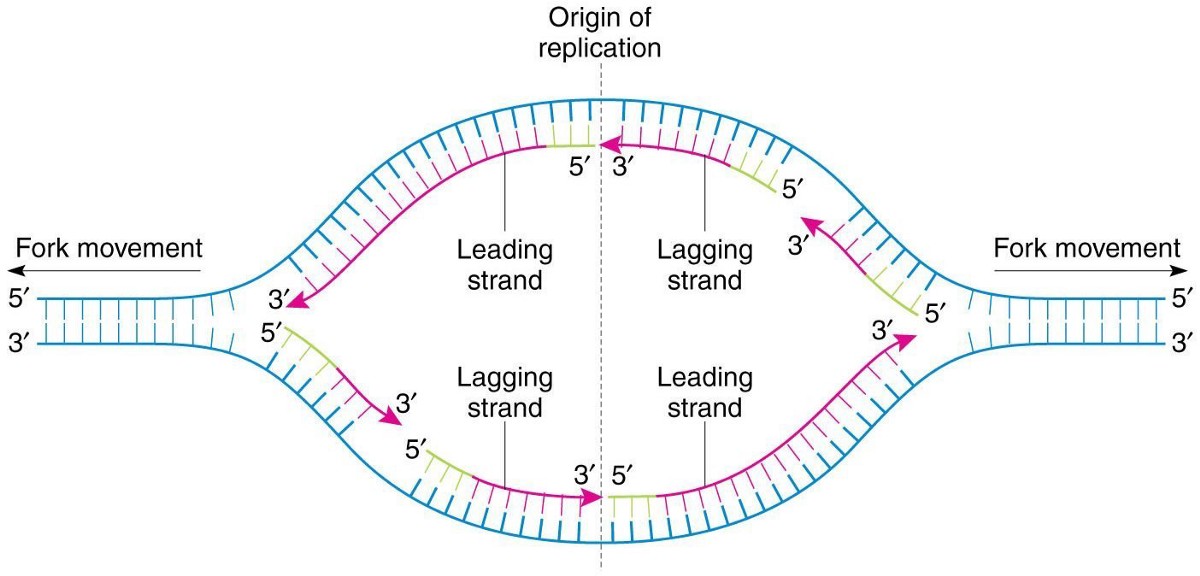
The normal structure of our DNA when not copied is a double helix. This looks a lot like a spiral staircase. In this normal form, DNA cannot be copied. DNA helicase is needed to open the DNA and expose the nucleotide bases that are used as a template to replicate the DNA. The area of ​​DNA that the DNA helicase opens is known as the replication fork because it looks a lot like a fork in the road.

The role of the replication fork

The replication fork is the area where DNA replication will actually take place. There are two strands of DNA that are exposed once the double helix opens. One strand is called the leading strand and the other strand is called the lagging strand. The leading strand is exposed in the 5′-3′ direction, while the lagging strand is exposed in the 3′-5′ direction. DNA is always copied in the 5′-3′ direction.

As the main strand is exposed, DNA polymerase will use the main strand as a template to create a continuous complementary strand of DNA. As the lagging strand is exposed, RNA primers are needed to start the replication process. The RNA primer will bind to the most 5′ end of the exposed part of the lagging strand. This primer then allows DNA polymerase to bind and add the complementary strand to the lagging strand in small segments known as Okazaki fragments.

Recent Posts

  • Veterinary Rapid Tests : A Comprehensive Guide to Point-of-Care Diagnostics in Animal Health
  • (no title)
  • Clean-Up Beads: A Comprehensive Guide to Magnetic Bead–Based Purification in Molecular Biology
  • DNA Library Preparation Single Enzyme: A Comprehensive Guide to Streamlined NGS Library Construction
  • Ultima Pro PCR-Free DNA Library Prep Kit V2: an exhaustive laboratory guide to unbiased next-generation sequencing library construction

Categories

  • Anti-tumoral Effects of Recombinant Lactococcus lactis Strain Secreting IL-17A Cytokine.
  • Antibodies
  • Assay Kits
  • Biology Cells
  • Blog
  • cDNA
  • Clia Kits
  • Culture Cells
  • Devices
  • DNA
  • DNA Templates
  • DNA Testing
  • Elisa Kits
  • Enzymes
  • Equipments
  • Exosomes
  • Gels
  • In vitro spleen cell cytokine responses of adult mice immunized with a recombinant PorA (major outer membrane protein [MOMP]) from Campylobacter jejuni.
  • Isotypes
  • Main
  • Medium & Serums
  • NATtrol
  • Panel
  • PCR
  • Peptides
  • Recombinant horse interleukin-4 and interleukin-10 induced a mixed inflammatory cytokine response in horse peripheral blood mononuclear cells.
  • Recombinant Proteins
  • Ria Kits
  • RNA
  • Test Kits
  • Vector & Virus

Recent Posts

  • Veterinary Rapid Tests : A Comprehensive Guide to Point-of-Care Diagnostics in Animal Health
  • (no title)
  • Clean-Up Beads: A Comprehensive Guide to Magnetic Bead–Based Purification in Molecular Biology
  • DNA Library Preparation Single Enzyme: A Comprehensive Guide to Streamlined NGS Library Construction
  • Ultima Pro PCR-Free DNA Library Prep Kit V2: an exhaustive laboratory guide to unbiased next-generation sequencing library construction

Tags

particles particles pcr pcram pcrb pcr covid test pcr covid testing pcrdfans pcre pcr kits price pcr test for coronavirus pcr test for covid 19 pcr testing for covid-19 pcr tests pcr unit peptides for nerve repair peptides for sale peptides for skin peptides for weight loss peptides international peptides rodan and fields peptides serum peptides supplement peptides t3 peptides tadalafil serums.com serums for hair growth serums for men serums for sensitive skin serums for wrinkles serums in anoka serums in anoka mn serums mn serums osrs serums peru serumstat serums ulta serums vs creams serums with glycerin serums with spf SOCS1 SOCS2 SOCS3 SOCS4 SOCS5 SOCS6
©2026 Macroarray | Built using WordPress and Responsive Blogily theme by Superb