Next-generation sequencing (NGS) has reshaped modern biological research by enabling high-resolution analysis of genomes, epigenomes, and complex genetic variation at unprecedented scale. While sequencing platforms continue to evolve rapidly, library preparation remains the most critical upstream determinant of sequencing data quality. Among all library preparation strategies, PCR-free DNA library preparation is widely regarded as the gold standard for applications where accuracy, coverage uniformity, and faithful representation of the original genome are essential.
The Ultima Pro PCR-Free DNA Library Prep Kit V2 is designed to support these advanced research requirements by enabling high-fidelity NGS library construction without PCR amplification, thereby minimizing technical bias and preserving true genomic complexity. This comprehensive article explores the scientific foundations, workflow considerations, applications, advantages, limitations, and best practices of PCR-free DNA library preparation in modern research laboratories.
The central role of library preparation in NGS data quality
In a typical NGS workflow, DNA library preparation acts as the molecular interface between biological samples and sequencing instruments. Errors or bias introduced at this stage propagate throughout the entire dataset and cannot be corrected computationally.
PCR-based amplification steps are a well-documented source of distortion in sequencing data, contributing to:
-
GC bias
-
Uneven genome coverage
-
Artificial duplication
-
Polymerase-induced nucleotide substitutions
These effects are extensively discussed in NIH-supported sequencing methodology reviews
https://www.ncbi.nlm.nih.gov/pmc/articles/PMC3836183/
https://www.ncbi.nlm.nih.gov/pmc/articles/PMC4010174/
https://www.ncbi.nlm.nih.gov/books/NBK568293/
As a result, PCR-free workflows have become increasingly important in applications where quantitative accuracy and structural integrity of genomic data are priorities.
What defines PCR-free DNA library preparation?
PCR-free DNA library preparation refers to NGS workflows in which adapter-ligated DNA fragments are sequenced directly without amplification. By removing the PCR step, the library retains the native fragment length distribution, base composition, and molecular abundance of the input DNA.
This approach is particularly recommended for:
-
Whole-genome sequencing (WGS)
-
Structural variant detection
-
Population genomics
-
Reference genome construction
-
Cancer genomics research
https://www.genome.gov/genetics-glossary/Library-Preparation
https://www.ncbi.nlm.nih.gov/pmc/articles/PMC4728800/
Molecular consequences of PCR amplification in NGS workflows
PCR amplification introduces bias through multiple mechanisms:
GC bias
PCR efficiency varies with GC content, leading to under-representation of GC-rich or GC-poor regions
https://www.ncbi.nlm.nih.gov/pmc/articles/PMC4010174/
Polymerase error accumulation
Each amplification cycle introduces a risk of base substitution or indel formation
https://www.ncbi.nlm.nih.gov/pmc/articles/PMC6602304/
Loss of molecular complexity
PCR duplicates artificially inflate read counts while reducing usable unique fragments
https://www.ncbi.nlm.nih.gov/pmc/articles/PMC3836183/
Quantitative distortion
Amplification disrupts true allele frequencies, especially in heterogeneous samples
https://www.ncbi.nlm.nih.gov/pmc/articles/PMC4728800/
PCR-free workflows eliminate these effects at the source.
Scientific foundation of PCR-free library preparation
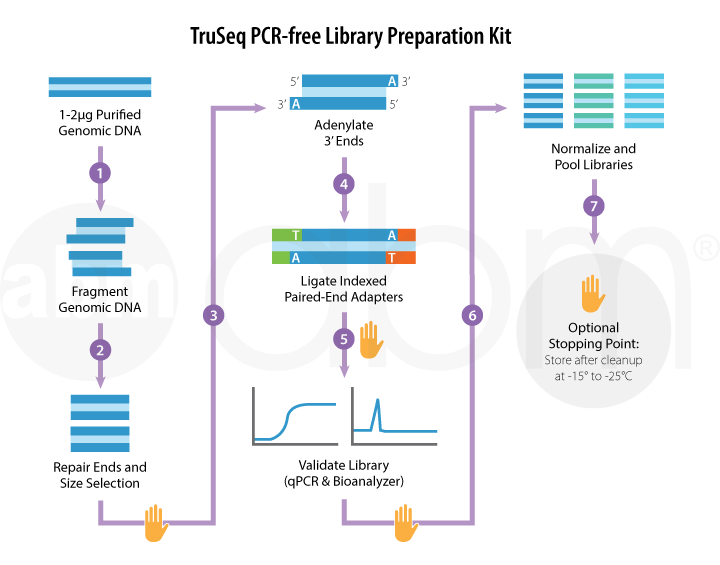
PCR-free library preparation relies on high-quality genomic DNA and efficient adapter ligation chemistry. Because no amplification compensates for losses, each step must preserve DNA integrity and yield.
The fundamental steps include:
-
Controlled DNA fragmentation
-
End repair and A-tailing
-
Adapter ligation
-
Size selection and purification
-
Direct sequencing
Each step is described in NIH and NCBI protocol guidance
https://www.ncbi.nlm.nih.gov/books/NBK568293/
https://www.ncbi.nlm.nih.gov/pmc/articles/PMC4728800/
DNA input requirements and quality considerations
PCR-free workflows require higher DNA input compared to PCR-based methods. This requirement reflects the absence of amplification and the need to maintain library complexity.
Key DNA quality metrics include:
-
High molecular weight DNA
-
Minimal fragmentation prior to shearing
-
A260/A280 ratio ~1.8
-
Absence of inhibitors
https://www.genome.gov/about-genomics/fact-sheets/DNA-Sequencing-Fact-Sheet
https://www.ncbi.nlm.nih.gov/books/NBK568293/
High-quality DNA extraction and handling are therefore essential prerequisites.
Fragmentation strategies for PCR-free libraries
Fragmentation directly influences insert size distribution and sequencing performance.
Mechanical fragmentation
Acoustic shearing (e.g., ultrasonication) provides highly reproducible fragment sizes
https://www.ncbi.nlm.nih.gov/pmc/articles/PMC4010174/
Enzymatic fragmentation
While convenient, enzymatic methods must be carefully optimized to avoid sequence bias
https://www.ncbi.nlm.nih.gov/pmc/articles/PMC6602304/
Mechanical fragmentation is often preferred for PCR-free workflows due to its consistency.
End repair, A-tailing, and adapter ligation
After fragmentation, DNA ends are enzymatically repaired to produce ligation-ready molecules. Adapters compatible with sequencing platforms are then ligated to fragment ends.
Efficient ligation is critical, as there is no amplification step to rescue poorly ligated fragments
https://www.ncbi.nlm.nih.gov/pmc/articles/PMC4728800/
Size selection and cleanup
Magnetic bead-based size selection ensures removal of:
-
Adapter dimers
-
Undesired fragment lengths
-
Reaction contaminants
Proper size selection improves cluster generation and sequencing efficiency
https://www.ncbi.nlm.nih.gov/pmc/articles/PMC6602304/
Library quality control metrics
Before sequencing, PCR-free libraries are evaluated for:
-
Fragment size distribution
-
Concentration
-
Absence of adapter dimers
-
Complexity
These QC steps align with NIH-recommended sequencing workflows
https://www.ncbi.nlm.nih.gov/books/NBK568293/
Applications of PCR-free DNA library preparation
Whole-genome sequencing (WGS)
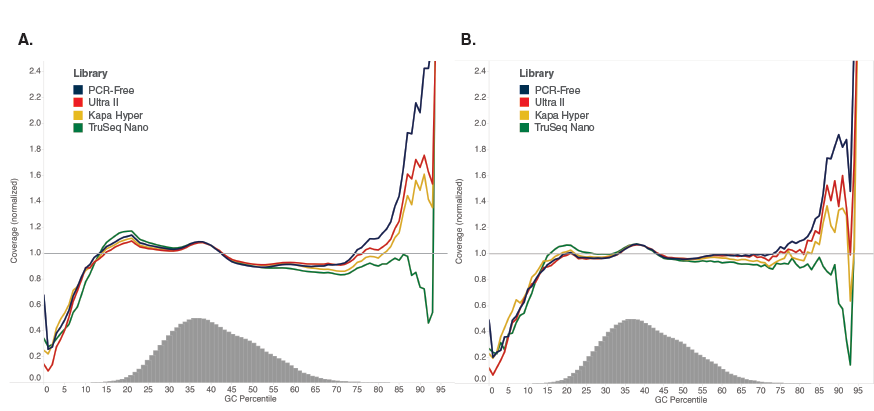
PCR-free libraries provide superior coverage uniformity and reduced duplication
https://www.ncbi.nlm.nih.gov/pmc/articles/PMC4728800/
Structural variant analysis
Preserved fragment integrity improves breakpoint resolution
https://www.ncbi.nlm.nih.gov/pmc/articles/PMC4010174/
Population and evolutionary genomics
Accurate allele frequency estimation is essential for population studies
https://www.ncbi.nlm.nih.gov/pmc/articles/PMC3836183/
Cancer genomics research
Reduced amplification artifacts improve somatic variant detection
https://www.cancer.gov/about-cancer/causes-prevention/genetics
https://www.ncbi.nlm.nih.gov/pmc/articles/PMC6602304/
Data quality improvements associated with PCR-free libraries
Multiple studies report:
-
Lower duplication rates
-
Reduced GC bias
-
Improved coverage uniformity
-
Higher confidence variant calls
https://www.ncbi.nlm.nih.gov/pmc/articles/PMC4728800/
https://www.ncbi.nlm.nih.gov/books/NBK568293/
Limitations of PCR-free workflows
PCR-free library preparation is not universally applicable:
-
Requires higher DNA input
-
Less suitable for degraded samples
-
Not ideal for ultra-low input workflows
Alternative strategies may be required for FFPE or low-biomass samples
https://www.ncbi.nlm.nih.gov/pmc/articles/PMC4010174/
Best laboratory practices for PCR-free success
-
Use freshly extracted, high-quality DNA
-
Validate fragmentation parameters
-
Maintain nuclease-free conditions
-
Perform accurate size selection
-
Apply consistent QC checkpoints
https://www.genome.gov/genetics-glossary/Next-Generation-Sequencing
https://assayguidancemanual.nih.gov/
Introducing the Ultima Pro PCR-Free DNA Library Prep Kit V2 (product)
The Ultima Pro PCR-Free DNA Library Prep Kit V2 is engineered to support high-confidence NGS workflows where bias minimization and data integrity are critical. The kit enables:
-
PCR-free library construction
-
Preservation of native genome representation
-
Reduced duplication and GC bias
-
High-quality whole-genome sequencing results
It integrates smoothly into established NGS pipelines and supports research-grade genomic analysis across a wide range of applications.
Key academic and government references
-
NIH Assay Guidance Manual
https://assayguidancemanual.nih.gov/ -
NCBI Bookshelf: Next-Generation Sequencing
https://www.ncbi.nlm.nih.gov/books/NBK568293/ -
Genome.gov NGS overview
https://www.genome.gov/genetics-glossary/Next-Generation-Sequencing -
PCR bias in NGS
https://www.ncbi.nlm.nih.gov/pmc/articles/PMC4010174/ -
PCR-free WGS performance
https://www.ncbi.nlm.nih.gov/pmc/articles/PMC4728800/