Introduction of Genetic Variation in Meiosis
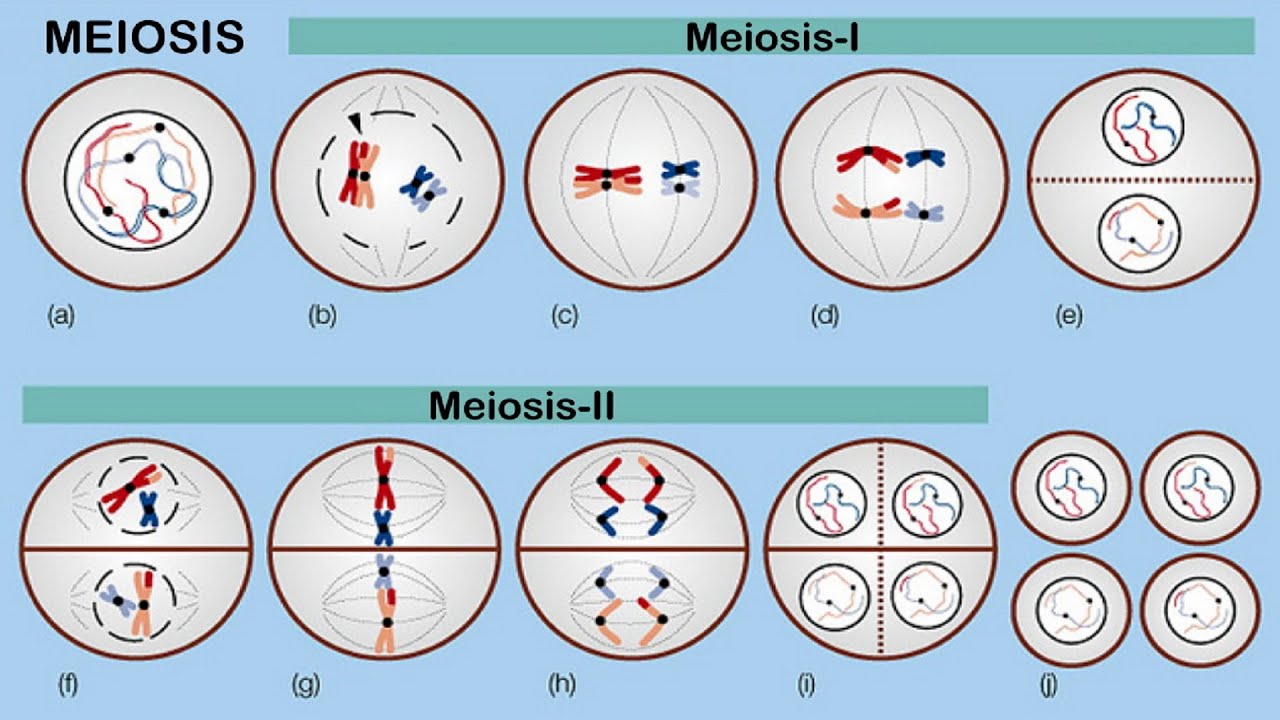
The gametes produced in meiosis are not genetically identical to the initial cell and they are not identical to each other. As an example, consider the meiosis, which shows the end products of meiosis for a simple cell with a diploid number of 2n = 4 chromosomes. The four gametes produced at the end of meiosis II are slightly different, each with a unique combination of the genetic material present in the initial cell.
It turns out that there are many more types of potential gametes than the four, even for a simple cell with only four chromosomes. This diversity of possible gametes reflects two factors: crossing over and the random orientation of meiosis I.
Crossing. The points where homologues cross and exchange genetic material are chosen more or less randomly and will be different in each cell that goes through meiosis. If meiosis occurs many times, as it does in the human ovaries and testes, the crossovers will occur at many different points. This repetition produces a wide variety of recombinant chromosomes, chromosomes in which pieces of DNA have been exchanged between homologues.
Random orientation of homologous pairs. Random orientation of homologous pairs during metaphase of meiosis I is another important source of gamete diversity.

What exactly does random orientation mean here? Well, a homologous pair consists of one homolog from your dad and one from your mom, and you have 23 pairs of homologous chromosomes in total, counting X and Y as homologs for this purpose. During meiosis I, the homologous pairs will separate to form two equal groups, but it is not usually the case that all the paternal (daddy) chromosomes go to one group and all the maternal (maternal) chromosomes go to the other.
Instead, each homologous pair will flip a coin to decide which chromosome belongs to which group. In a cell with only two pairs of homologous chromosomes, like the one on the right, the random orientation of metaphase allows for 22 = 4 different types of possible gametes. In a human cell, the same mechanism allows for 223 = 8,388,608 different types of possible gametes. And that’s not even considering the crossovers!
Given those kinds of numbers, it’s highly unlikely that any two sperm or eggs produced by one person will be the same. It is even more unlikely that you and your sister or brother are genetically identical, unless you are identical twins, thanks to the process of fertilization (in which a single egg cell from mom combines with a single sperm cell from dad, forming a zygote whose genotype is well beyond one in a trillion!).
Meiosis and fertilization create genetic variation by making new combinations of genetic variants (alleles). In some cases, these new combinations can make an organism more or less fit (able to survive and reproduce), thus providing the raw material for natural selection. Genetic variation is important in allowing a population to adapt through natural selection and thus survive in the long term.