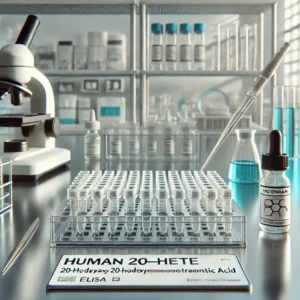
The Human 20-Hydroxyeicosatetraenoic Acid (20-HETE) ELISA Kit is an advanced assay designed for the precise measurement of 20-HETE in biological samples. As a bioactive eicosanoid, 20-HETE plays a critical role in various physiological and pathological processes, including blood pressure regulation, vascular function, and renal physiology. This article explores the importance of 20-HETE, the applications of ELISA kits, and how they are transforming research in key areas of health and disease.
What is 20-HETE?
20-Hydroxyeicosatetraenoic acid (20-HETE) is a cytochrome P450-derived metabolite of arachidonic acid. It is an eicosanoid with significant roles in vascular tone regulation, sodium handling in the kidney, and overall cardiovascular health. Produced predominantly in the kidney, brain, and vasculature, 20-HETE has both vasoconstrictive and vasodilative properties, depending on the context and tissue involved.
- For a detailed biochemical overview, visit the National Center for Biotechnology Information (NCBI).
- Additional information on eicosanoid biosynthesis is available at PubMed.
Physiological and Pathological Roles of 20-HETE
1. Cardiovascular Health
20-HETE plays a key role in regulating blood pressure and vascular function. Dysregulation of 20-HETE levels is associated with hypertension and vascular diseases. The American Heart Association provides detailed insights into the role of eicosanoids in cardiovascular health.
2. Kidney Function
As a major regulator of renal function, 20-HETE is involved in sodium excretion and the maintenance of renal blood flow. Research on its role in renal pathophysiology is available through the National Institute of Diabetes and Digestive and Kidney Diseases (NIDDK).
3. Neurological Implications
Emerging studies suggest that 20-HETE contributes to cerebral blood flow regulation and may be implicated in conditions like stroke and cerebral edema. Learn more from the National Institute of Neurological Disorders and Stroke (NINDS).
4. Cancer Progression
Elevated 20-HETE levels have been linked to tumor angiogenesis and cancer progression. The National Cancer Institute (NCI) provides extensive resources on cancer biomarkers like 20-HETE.
Applications of the Human 20-HETE ELISA Kit
The Human 20-HETE ELISA Kit is widely used in basic and clinical research to measure 20-HETE levels across a variety of samples, such as plasma, serum, and urine. Applications include:
1. Hypertension Research
The kit helps quantify 20-HETE levels to explore its role as a biomarker for hypertensive disorders. Guidelines on hypertension research are available at the Centers for Disease Control and Prevention (CDC).
2. Renal Disease Studies
By detecting dysregulated 20-HETE levels, researchers can investigate its involvement in chronic kidney disease (CKD) and acute kidney injury (AKI). Additional resources are available through the National Kidney Foundation.
3. Neurological Disorders
The kit is essential in studying 20-HETE’s role in stroke and traumatic brain injury (TBI). Relevant research can be found at ClinicalTrials.gov.
4. Cancer Research
20-HETE is increasingly recognized as a therapeutic target in angiogenesis and tumor microenvironment modulation. Learn more from the NIH Cancer Research Portfolio.
Features of the Human 20-HETE ELISA Kit
- High Sensitivity and Specificity: Detects minute quantities of 20-HETE, ensuring reliable results. Learn about assay design and sensitivity standards at NIST.
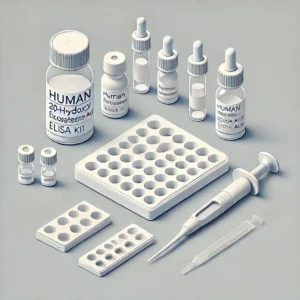
- User-Friendly Protocol: The kit includes pre-coated plates, ready-to-use reagents, and a detailed protocol, making it ideal for researchers of all skill levels.
- Wide Sample Compatibility: Suitable for diverse sample types, including plasma, serum, and urine. Read about sample preparation best practices at Mayo Clinic Research Laboratories.
How Does the 20-HETE ELISA Kit Work?
The enzyme-linked immunosorbent assay (ELISA) operates on the principles of antigen-antibody interaction. Here’s a step-by-step overview:
- Coating: The microplate is pre-coated with a capture antibody specific to 20-HETE.
- Blocking: Non-specific binding sites are blocked using a proprietary buffer.
- Sample Addition: Biological samples or standards containing 20-HETE are added.
- Detection: A detection antibody conjugated to an enzyme (e.g., horseradish peroxidase) binds to the antigen.
- Signal Generation: A substrate reacts with the enzyme, producing a colorimetric signal proportional to 20-HETE concentration. For technical details, refer to the NIH Assay Guidance Manual.
Advantages of Using the Human 20-HETE ELISA Kit
- Quantitative Analysis: Offers precise quantification of 20-HETE levels.
- High Throughput: Designed for analyzing multiple samples simultaneously, making it ideal for large-scale studies.
- Reproducibility: Ensures consistent results across experiments, meeting international standards for assay validation (FDA Biomarker Qualification Program).
Translational Applications and Future Directions
The 20-HETE ELISA Kit bridges the gap between basic science and clinical applications. Its use is critical for:
- Biomarker Discovery: Identifying 20-HETE as a diagnostic and prognostic marker in diseases. Explore more at Science.gov.
- Therapeutic Targeting: Developing inhibitors or modulators of 20-HETE for therapeutic interventions (NIH Drug Development Resources).
Looking forward, advances in eicosanoid research, supported by the National Science Foundation (NSF), aim to uncover new therapeutic pathways and refine existing diagnostic tools.
Challenges in 20-HETE Research
While the 20-HETE ELISA Kit is a robust tool, some challenges remain:
- Matrix Effects: Variability in biological sample matrices can influence results. Guidance on minimizing these effects is available from the CDC Laboratory Standards.
- Emerging Technologies: Techniques like liquid chromatography-mass spectrometry (LC-MS) are being developed as complementary methods. Read more at NIH Metabolomics Research.
Conclusion
The Human 20-HETE ELISA Kit is an indispensable tool for advancing our understanding of the physiological and pathological roles of 20-HETE. By enabling precise quantification of this bioactive eicosanoid, the kit supports critical research in hypertension, kidney disease, cancer, and more.
For further resources, explore:
- Harvard Medical School’s Cardiovascular Research
- Johns Hopkins Medicine: Vascular Biology
- NIH Office of Research on Women’s Health
With ongoing advancements in assay technologies and their applications, the 20-HETE ELISA Kit continues to be a cornerstone in biomedical research.